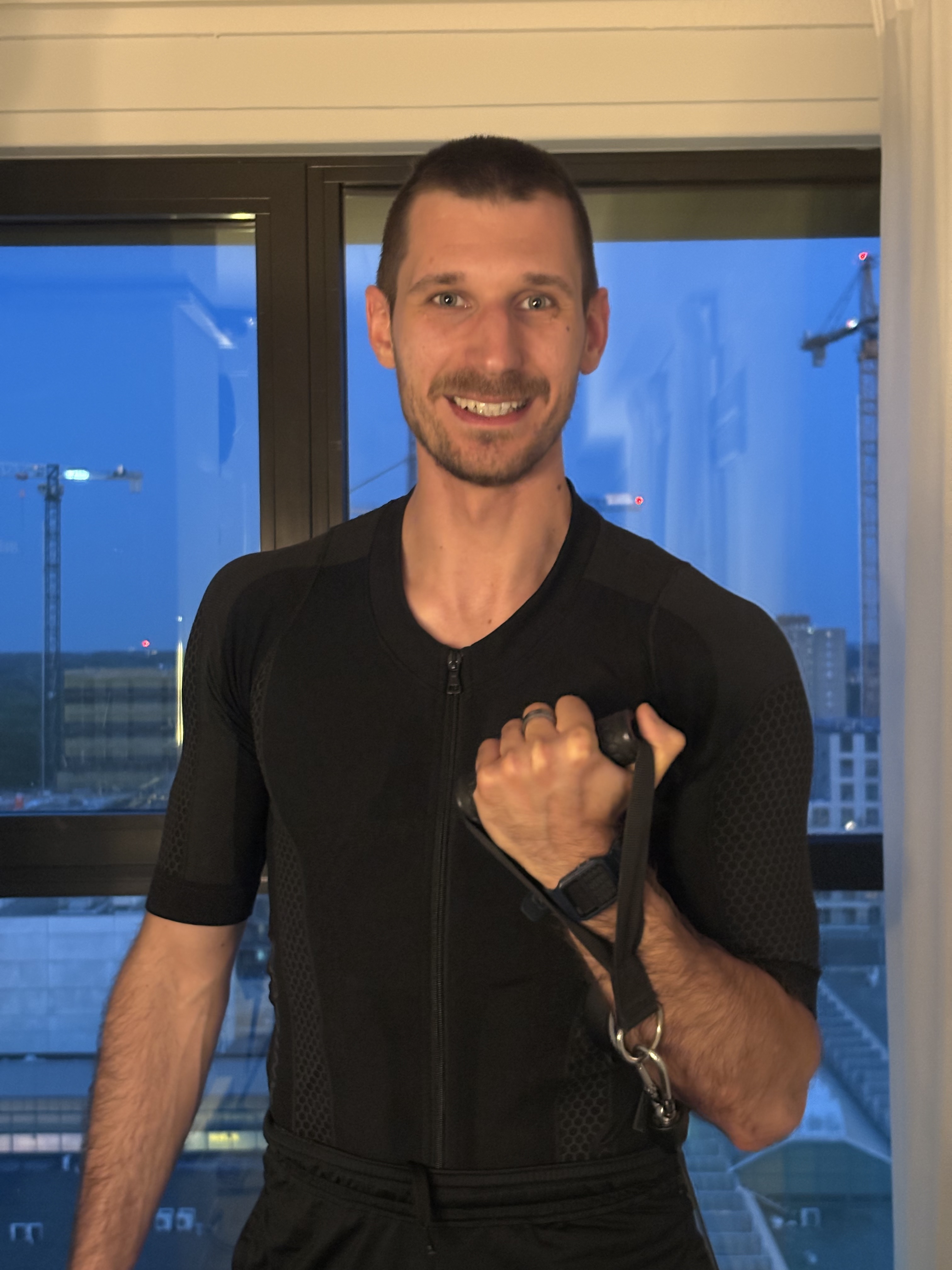
Former member of the Italian national athletics team, competing in the 200m sprint at national and European level from 2015 to 2019. Those years gave me a perspective on performance that no degree can replicate — what the body signals at its limit, and where conventional wisdom simply does not hold up.
After competition I studied Sports Science and Engineering — two cultures that rarely talk to each other, which is exactly the problem I am trying to solve. Today I work as a rapid-prototype engineer in sport-tech: building sensors, embedded systems, and computer-vision tools to test ideas quickly, before serious resources are committed.
How I think
First principles before received wisdom
I go back to fundamentals every time — sport is full of practices that were never properly questioned, and engineering often adds complexity where simplicity would work better.
Validate with a prototype, not a slide deck
A working prototype in front of real athletes tells you more in one session than months of planning. The field is ruthless and honest. A spreadsheet is neither.
Connect domains that rarely talk to each other
The most interesting solutions sit at disciplinary boundaries. Cross-domain thinking consistently produces ideas that neither field would have reached on its own.
Mission
Combine sport and engineering to push performance forward.
Vision
Technology that makes training smarter, faster, and more efficient.
Latest articles
Sport
Why Better Gym Machines Won't Make You Fitter
The fitness industry keeps building better machines for the people least equipped to use them.
12 Sept 2026
Engineering
IMU Sensors in Sport: Why Understanding Quaternions Is Non-Negotiable
When a barbell rotates, its IMU sensor stops measuring the right axis. Quaternions and the Madgwick filter fix this — here is how they work and why every sport sensor needs them.
3 Sept 2026
Sport
You're Not Overtrained. You're Lazy!
Overtraining is real, but it's much harder to reach than most people think.
24 Aug 2026
Engineering
I Let an AI Tune My Firmware for 40 Iterations. It Made Things Worse.
An honest account of trying to automate firmware parameter tuning with Claude Code, what the setup looked like, why it failed, and what it taught me about where AI actually breaks down.
4 Aug 2026
Sport
The Heavy Legacy of Vittori and Mennea: How a Method Built Around One Outlier Held Back Italian Sprinting
A generation of sprinters ruined by a common misconception
9 Jul 2026
Engineering
NRF24L01: the cheap 2.4 GHz radio that actually works in the field — if you know where it hides
A practical guide to building wireless sensor networks with the NRF24L01 — what makes it the right choice for sport-tech field devices, and the one hardware mistake that cost me over a year of troubleshooting.
21 Jun 2026
Engineering
IMU sensors: why the accelerometer and gyroscope are useless alone — and powerful together
A clear explanation of what accelerometers and gyroscopes actually measure, why each one fails on its own, and how combining them with a complementary filter solves both problems at once.
20 Jun 2026
Sport
Accommodating resistance: how bands and chains fix the fundamental flaw in barbell training
Why a constant-weight barbell is never the optimal load throughout a lift — and how variable resistance fixes it, what the research says about how much to use, and which exercises actually benefit.
19 Jun 2026
Sport
Velocity-Based Training: how bar speed tells you more than the weight on the bar
A practical guide to VBT — what it measures, why it beats percentage-based programming for finding your optimal training load, and which exercises actually benefit from it.
18 Jun 2026
Projects
How I Turned a Cheap Alarm Clock Into a Heads-Up Display for My Runs (Part 2)
Wiring the ESP32, staring down a Chinese datasheet, and spending half a day brute-forcing a segment map — until the display finally showed the right number.
17 Jun 2026
Projects
How I Turned a Cheap Alarm Clock Into a Heads-Up Display for My Runs (Part 1)
Reverse-engineering a projection alarm clock, an ESP32, and a heart-rate strap into a training device that throws my data on the wall in front of me.
16 Jun 2026
General
Welcome — where sport meets the soldering iron
Former national-team athlete, dual degrees in Sport Science and Engineering, fifteen-plus years of daily training. This is where I write about all of it.
15 Jun 2026
Building something in sport-tech?
Working on a sport-tech idea? I can help you stress-test assumptions, validate quickly, and figure out what to build first.