Accommodating resistance: how bands and chains fix the fundamental flaw in barbell training
The barbell doesn’t know where you’re strong
Pick up a barbell and squat with it. At the bottom of the movement, your muscles are at a mechanical disadvantage — hip angle, knee angle, and muscle length all conspire against you. Near the top, as your legs approach extension, you’re in a far stronger position. The mechanics improve dramatically as you rise.
The barbell doesn’t care. It weighs the same at every point of the movement.
This mismatch is not a minor inconvenience. It’s a structural flaw in how most strength training is done, and it has a name: the sticking point.
The sticking point: your ceiling is set by your weakest position
The sticking point is the point in a lift where the bar decelerates — not because you’re running out of effort, but because the resistance temporarily exceeds what your muscles can produce at that specific joint angle and muscle length.
Interestingly, the sticking point is not simply the most mechanically disadvantaged angle, as you might expect. It’s the point where the combination of muscle force capacity and mechanical advantage reaches its minimum — a specific zone in the range of motion where multiple factors align against you at the same time.
The consequence is straightforward: the maximum load you can lift through the full range of motion is determined by how much you can handle at your weakest point. Every position where you have a mechanical advantage — the lock-out of a squat, the top of a bench press, the last third of a deadlift — is undertaken with weight that’s well below what those positions could handle. You’re under-loading your strongest positions every single repetition.
For general fitness, this is acceptable. For athletes trying to maximise force production, it’s a systematic waste of training stimulus.
The idea behind accommodating resistance
The solution, at least in principle, is simple: make the resistance change with the movement. Load less weight at the bottom — where you’re weakest — and progressively more as you rise toward the position where your mechanical advantage grows.
This is what accommodating resistance, also called Variable Resistance Training (VRT), attempts to do. By attaching bands or chains to the barbell, the resistance increases as you move toward full extension, closely mirroring the natural increase in your force production capacity as joint angles become more favourable.
The result is a fundamentally different stimulus. You’re now facing meaningful resistance throughout the entire range of motion, not just at the sticking point. The muscles — and the nervous system — are asked to work hard at every joint angle, not just at the weakest one.
Two tools: bands and chains
Both elastic bands and chains achieve accommodating resistance, but they do it differently, and the distinction matters practically.
Chains work through simple mechanics: as the bar rises during a squat or deadlift, more chain links are lifted off the floor. The resistance increases linearly — each centimetre of bar travel picks up a predictable additional weight. The load profile is clean and easy to quantify: if you know how much each chain weighs per unit length, you know exactly how much resistance you’re adding at any point in the lift. The downside is practicality — chains are heavy, bulky, and need to be transported and set up correctly, with a starting position calibrated so that all the links are on the floor at the bottom of the lift and fully suspended at the top.
Bands have a different load curve. Elastic resistance increases non-linearly as the band stretches — the tension grows more steeply in the early part of the stretch and levels off toward the end. This actually maps reasonably well onto the ascending force curve of exercises like the squat, but it makes exact load quantification difficult. Band tension depends on the material, the original length, the attachment method, temperature, and humidity. Manufacturers rarely provide detailed force curves — they typically specify only the breaking load. In practice, you need to measure or estimate the actual tension added by each band in your specific setup.
Bands also require an anchor point — something below the bar to pull against. That anchor point matters: attaching both ends of the band to the same point doubles the effective spring constant and significantly increases the tension per unit of displacement. The geometry of your setup directly determines how much load you’re adding.
The practical edge goes to bands for portability and versatility. The practical edge goes to chains for precision.
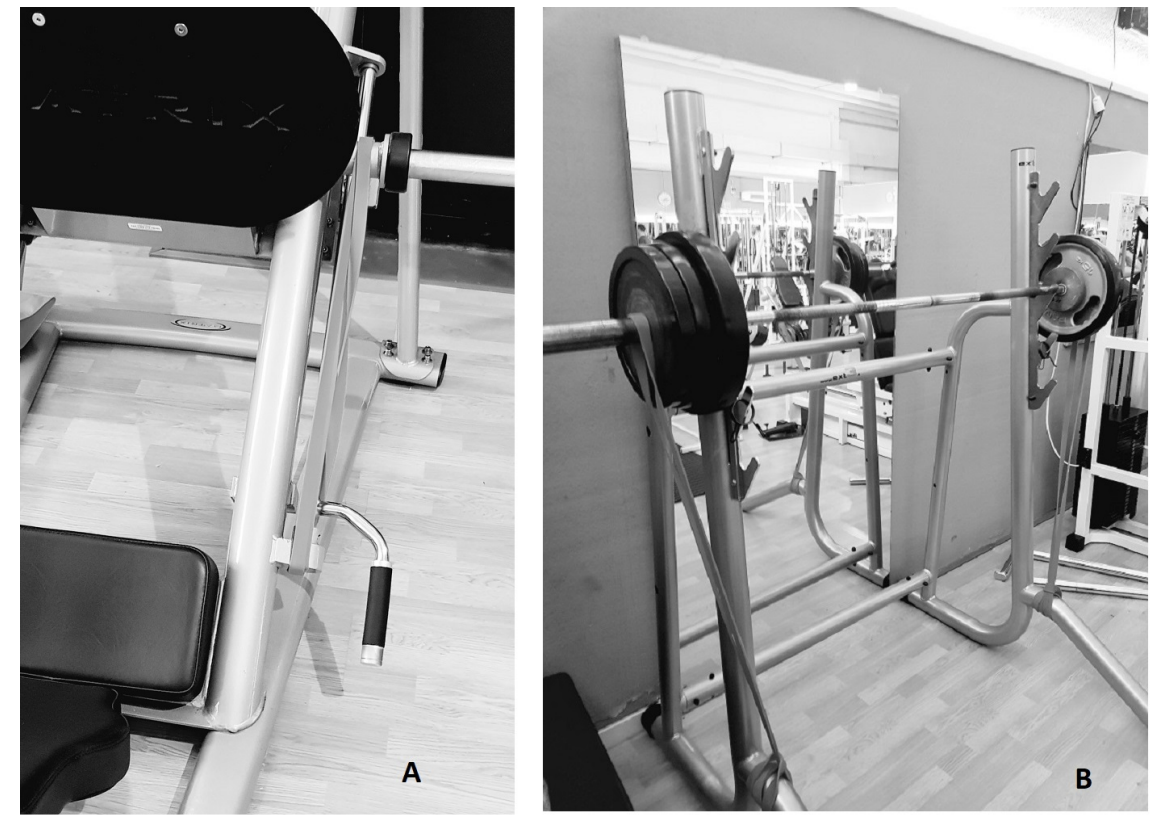
Which exercises benefit — and which don’t
Not all exercises have the same force-angle profile, and accommodating resistance only makes sense for specific shapes of curve.
Exercises with an ascending force curve are the natural candidates. These are lifts where the mechanical advantage increases as you move toward the end of the concentric phase — where you get progressively stronger as you rise. The squat, the bench press, the deadlift, and the overhead press all follow this pattern. At the bottom, the geometry is unfavourable; at the top, you’re locking out into a position where the same muscular effort produces far more external force. Adding bands or chains to these movements means the resistance is rising exactly as your capacity to produce force is rising. That’s the match you’re looking for.
Exercises with a descending force curve work the other way: you’re strongest at the start of the movement and weaker as you approach the end. Lat pulldowns, cable rows, and pull-ups fall into this category. The maximum load here is determined by the starting position, and adding accommodating resistance would make the hardest part — the bottom — even harder, while making the already-easier starting position even less demanding. The mismatch goes in the wrong direction.
When in doubt, ask where the sticking point is. If it’s near the bottom of the concentric phase — as in a squat or bench press — accommodating resistance can help. If there’s no clear sticking point or if strength decreases as the movement progresses, accommodating resistance is the wrong tool.
What the research says about load
One of the genuinely difficult things about accommodating resistance is deciding how much variable load to add. The research is not perfectly consistent here, but some useful patterns have emerged.
A variable component smaller than roughly 10% of the total load at peak tension produces no measurable benefit over conventional training. At that level, the added resistance is simply too small to meaningfully alter the mechanics of the lift.
Between 20% and 35% of the total load, things get interesting. Multiple studies report significant improvements in strength and power output — improvements that exceed what isotonic training produces with matched total loads. The nervous system response appears to be a key driver: athletes training with higher accommodating resistance percentages show greater EMG activation throughout the lift, suggesting broader neuromuscular recruitment across the full range of motion.
A commonly cited starting point for power development is a base load of around 85% of 1RM supplemented by a variable component targeting 20% of the lifted load. For speed-strength work — where the goal is moving submaximal loads as explosively as possible — a lighter base (around 50% 1RM) with a variable component sized to keep bar velocity between 0.7 and 0.8 m/s has produced strong gains.
One important caveat: accommodating resistance is consistently more effective in trained athletes than in beginners. The unstable bar path created by bands increases the neuromuscular coordination demand. For athletes who haven’t yet developed solid movement patterns, the added instability can interfere with technique without delivering the neural benefits that make the method worthwhile. The recommendation is to build a foundation with conventional loading first.
The kinetics: what actually changes in the lift
Beyond the force profile, accommodating resistance alters the kinetics of the movement in ways that are worth understanding.
In conventional barbell training, the standard strategy for moving a heavy load quickly is to accelerate hard early and then ease off as you approach the top — the bar’s own momentum carries it through the final phase. You’ve probably felt this: the explosive drive off the bottom, followed by a natural reduction in effort near the lock-out. This deceleration phase is actually a systematic limitation on the training stimulus. The muscles responsible for the final extension never face serious load because the lift is already finishing on momentum.
With accommodating resistance, the variable load acts as the braking force. Instead of the athlete deliberately decelerating the bar, the increasing resistance of the bands or chains does that work. This means the athlete can apply maximum intent and maximum acceleration throughout the entire concentric phase — there’s no point at which easing off becomes the rational strategy. The accelerative demand is extended, and with it, the neuromuscular stimulus.
The target kinetic signature of a well-executed variable resistance set is a velocity-time curve that shows continuous, steady acceleration — the bar moving faster and faster from the bottom through the top. If the velocity curve shows a plateau or a drop-off in the middle of the lift, either the base load is too light (not enough demand to extend the acceleration phase) or the variable component is overwhelming the athlete’s force production capacity at the bottom.
This is where the connection to the previous article on VBT becomes concrete. Monitoring bar velocity isn’t just a convenience — for accommodating resistance training specifically, the shape of the velocity-time curve is the primary diagnostic tool for whether the load split between constant and variable resistance is correct.
What comes next
The practical problem with using velocity to tune accommodating resistance loads is measurement. Encoders — the most accurate option — are cumbersome to integrate with band setups where the bar path may not be perfectly vertical. The more natural fit is an IMU sensor mounted directly on the bar.
That sensor choice, and what it takes to make it work well enough to be useful, is the subject of the next article.

Lodovico Cortelazzo
Former national-team athlete. 15 years of training. Exercise science and engineering.
Fifteen years of training, eight at national level, give a specific kind of eye for what sport technology actually does versus what it claims to do. I combine a background in exercise science with hands-on engineering to build and analyse tools that are meant to work in the real world. If you are working on something in this space and want that perspective, reach out.
Work with me →