Velocity-Based Training: how bar speed tells you more than the weight on the bar
The day the sensor proved me wrong
I remember a training session where I was convinced it wasn’t my day. The warm-up felt heavy. My legs were stiff. I was ready to dial everything back, train at sixty percent, go home and call it a controlled session.
The sensor disagreed.
The bar speed on my first working set was exactly where it should have been. Not slightly off — right on target. So I pushed. The session turned out to be one of the better ones that month.
Without that number, I would have made a decision based on how I felt — and how I felt was wrong. That’s the core promise of Velocity-Based Training: it gives you an objective window into your neuromuscular state on any given day, and it doesn’t care about your mood.
Where this came from
VBT isn’t new. The idea that bar velocity contains useful training information has been around since the 1990s, but it was the Spanish researcher Juan José González-Badillo who turned it into a systematic methodology. His work established something that now underpins the entire field: for any given exercise, there is a highly reproducible relationship between the relative load (as a percentage of your 1RM) and the mean velocity of the concentric phase.
In plain terms: if you squat at 60% of your 1RM, the bar will move at roughly the same speed every time you’re fresh — regardless of whether that 60% is 80 kg or 140 kg. The velocity is the fingerprint of the relative effort.
This observation opened a door. If velocity reliably maps to relative load, you don’t need to know your 1RM to train at a specific relative intensity. You just need to know what velocity corresponds to what intensity — and hit that velocity.
What VBT actually measures — and the detail most people skip
The standard metric in VBT is mean concentric velocity: the average speed of the bar during the lifting phase, measured in metres per second (m/s).
This is useful, and it’s what most VBT systems report. But there’s a subtlety worth understanding.
Velocity is the derivative of position over time. Acceleration is the derivative of velocity over time. And from Newton’s second law, force is mass times acceleration. So if what you’re actually trying to express is force — not just movement — then acceleration is the more direct measurement.
Mean velocity is a practical proxy that works well in most cases. But for explosive exercises like jump squats, where the entire point is maximal rate of force development rather than just moving the bar fast, paying attention to the acceleration profile can give you information that mean velocity alone doesn’t. This is something I’ve kept in mind when using VBT for power work — the headline number is useful, but it’s not the whole story.
Why percentage-based programming has a fundamental flaw
The traditional approach to loading is simple: find your 1RM, train at a percentage of it. Want to develop maximal strength? Work at 85-90%. Targeting power? Drop to 55-65%. Clean and consistent.
The problem is that your 1RM isn’t a fixed number. It fluctuates — daily, weekly, across a training block — based on fatigue, sleep quality, nutrition, accumulated stress. A well-recovered athlete and a fatigued athlete have genuinely different 1RMs on any given day, and percentage-based programming treats them the same.
The result is a mismatch. The athlete who is fresh gets under-stimulated. The athlete who is fatigued gets over-loaded. Both are training at “80% of 1RM” on paper, but the actual physiological stress is completely different.
VBT resolves this by anchoring load to velocity targets rather than fixed percentages. On a good day, you’ll hit your target velocity with more weight on the bar. On a bad day, you’ll hit the same velocity with less. The programming adjusts automatically to your actual state — no guesswork, no relying on yesterday’s numbers.
There’s a second benefit: 1RM estimation without a 1RM test. By measuring bar speed across several submaximal loads and extrapolating the load-velocity curve to the velocity at which you typically fail (approximately 0.15–0.20 m/s for the squat), you can predict your current 1RM with reasonable accuracy. This is genuinely useful for monitoring strength development over time without the fatigue cost of a true maximal test.
Velocity thresholds: which numbers to target for which goal
The research has converged on fairly consistent velocity ranges that correspond to different training adaptations. These are the zones I work with, based on González-Badillo’s framework and subsequent validation work:
| Velocity range (m/s) | Primary adaptation |
|---|---|
| < 0.20 | Absolute strength — near-maximal loads |
| 0.20 – 0.50 | Maximal strength |
| 0.50 – 0.75 | Strength-power |
| 0.75 – 1.00 | Maximum power output |
| 1.00 – 1.30 | Speed-strength |
| > 1.30 | Speed |
A few practical notes on these numbers:
They are exercise-specific. The velocity at which a squat corresponds to maximal strength is not the same as for a bench press or a Romanian deadlift. The table above is a general reference; the exact values shift depending on the lift and the individual. Most serious VBT practitioners build their own load-velocity profiles for each exercise.
The power zone deserves attention. The 0.75–1.00 m/s range is where maximum power output typically occurs — the load at which the product of force and velocity peaks. For exercises like the loaded squat jump, this is the zone you’re targeting if the goal is to maximise rate of force development. Moving too slowly means too much load, too little velocity contribution. Moving too fast means too little load, too little force contribution. The optimal zone sits between the two.
The thresholds are a starting point, not a prescription. Individual variation is real, and the honest use of these numbers is as a calibration baseline — not as fixed truth.
Where VBT works and where it doesn’t
VBT is genuinely useful for classic strength and power exercises where the movement pattern is consistent, the bar travels along a predictable path, and the goal is expressing force through that movement.
The squat, the bench press, the deadlift, the Romanian deadlift, the hip thrust, the loaded squat jump — these are all good candidates. The movement is repeatable, the velocity signal is clean, and the load-velocity relationship is stable enough to be informative.
Olympic lifts are a different story. In the snatch or the clean and jerk, technique is the dominant performance variable. A poorly executed snatch with a light load can be slower than a well-executed one with a heavy load — not because of insufficient force production, but because the bar path is inefficient. When technique variability is large enough to overwhelm the load-velocity relationship, velocity becomes a noisy signal. It’s measuring both force expression and technical efficiency at the same time, and you can’t cleanly separate the two. For Olympic lifts, velocity feedback can still be useful for experienced athletes with consistent technique, but it’s much less reliable as a primary load management tool.
The cleaner the movement pattern, the more useful VBT is.
How to measure bar velocity: encoder vs IMU
There are two main approaches, and they involve real trade-offs.
Linear position transducers (encoders)
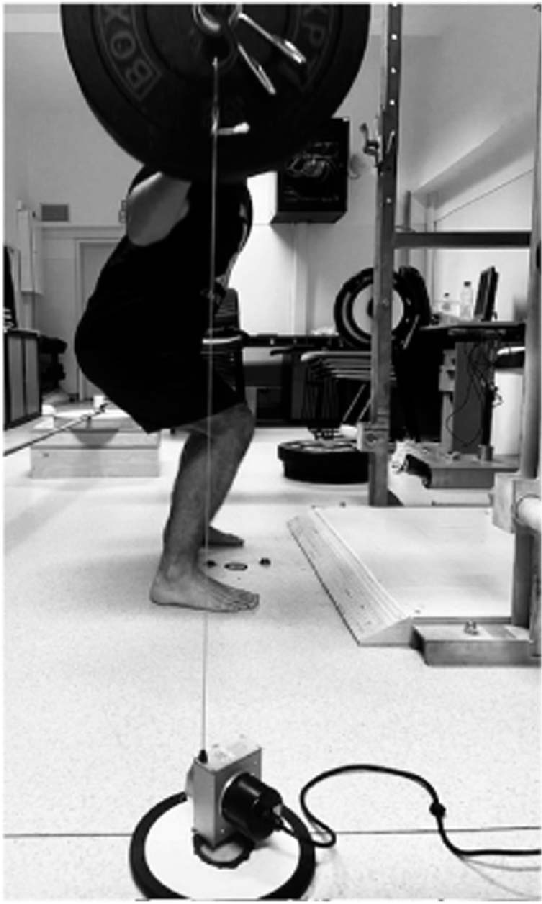
A linear position transducer — often called a velocity encoder or LPT — is a device with a retractable cable that you attach to the barbell. As the bar moves up and down, the cable extends and retracts, and the device measures exactly how far the bar has traveled over time. From position and time, it calculates velocity.
This is the gold standard for accuracy. The measurement is direct, the signal is clean, and for exercises where the bar moves vertically, the physics are straightforward. Commercial systems like the GymAware or the Push Band (in its encoder form) have built their reputation on this approach.
The limitation is physical: you need a cable attached to the bar, which means the device must be anchored to something stationary nearby. This works perfectly for squats, bench press, and deadlifts in a fixed rack. It becomes impractical for exercises involving rotation, complex bar paths, or movements where a trailing cable would interfere. You also need to set it up every session.
IMU sensors (accelerometers and gyroscopes)
An IMU (Inertial Measurement Unit) is a small sensor — typically combining a 3-axis accelerometer and a 3-axis gyroscope — that you clip or strap directly to the barbell. It measures acceleration in all three dimensions and angular rotation, then integrates those signals over time to estimate velocity.
The appeal is obvious: no cable, no fixed anchor, no setup complexity. You can use it on any exercise, in any environment. For movements with complex bar paths or for situations where an encoder simply won’t fit (a resisted sprint device, for instance), an IMU is often the only practical option.
The honest limitation is precision. Integrating acceleration to get velocity accumulates error over time — a well-known problem called integration drift. Cheap IMUs with poor algorithms produce noticeably noisy velocity estimates. But this is primarily a software and calibration problem, not a fundamental hardware limitation. A good sensor fusion algorithm, proper calibration, and quality hardware can close much of the gap with encoders, particularly for short explosive movements. The gap is narrowing.
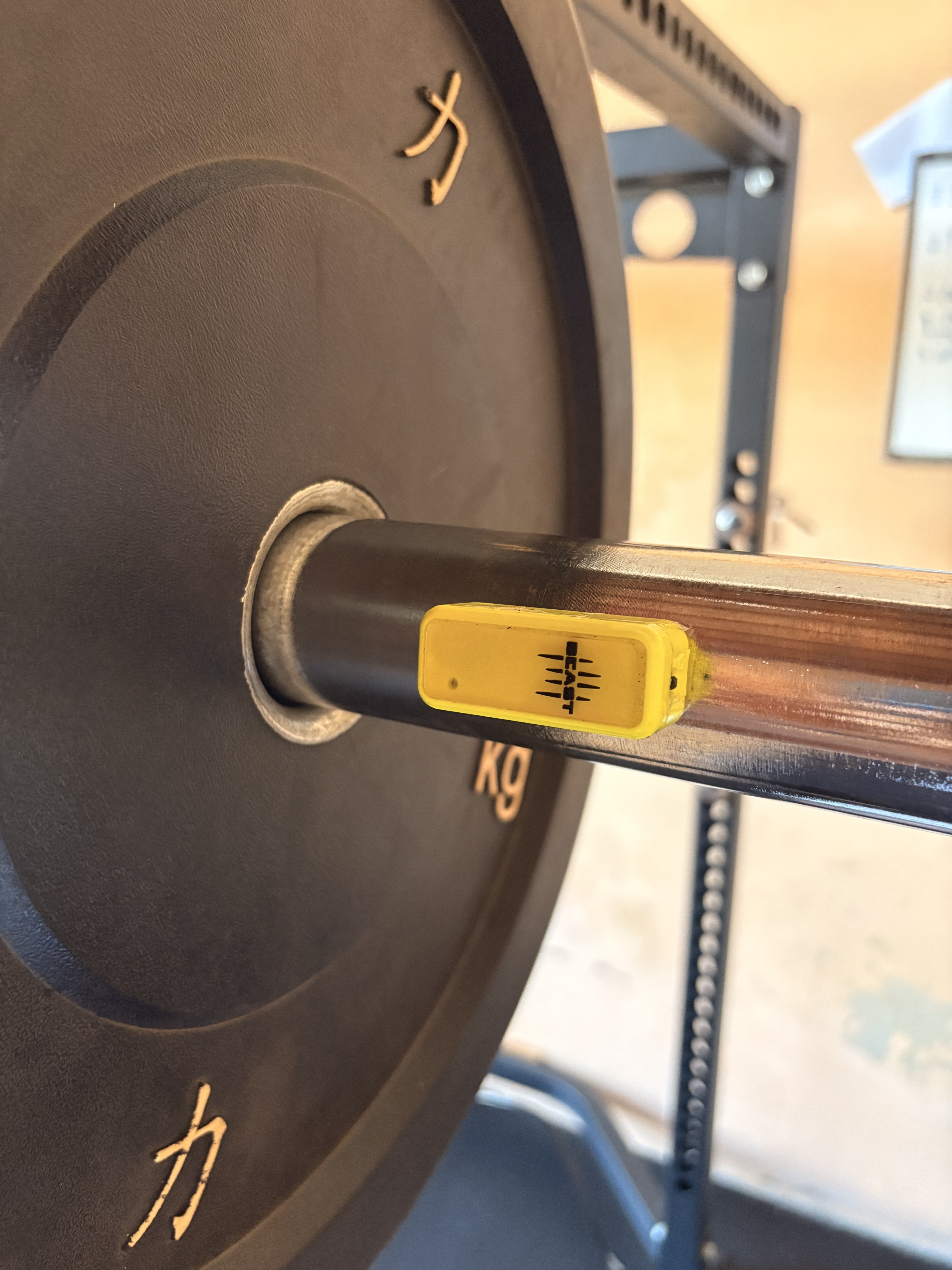
My honest take: for a fixed barbell in a squat rack, an encoder gives you cleaner data with less fuss. For anything else — and especially for devices you want to build or embed in novel training equipment — an IMU with a solid algorithm is the right tool.
What this sets up
VBT is the why behind measuring bar speed. The follow-up questions — what sensor to use, how to implement it in hardware, how to handle the signal — are where engineering enters the picture.
The next two articles cover both sides of that question. Accommodating resistance training introduces a loading variable that VBT alone wasn’t designed to handle. IMU sensors covers how the measurement hardware works, where its limits actually are, and what good algorithm design looks like. The combination of the two is where things get interesting.
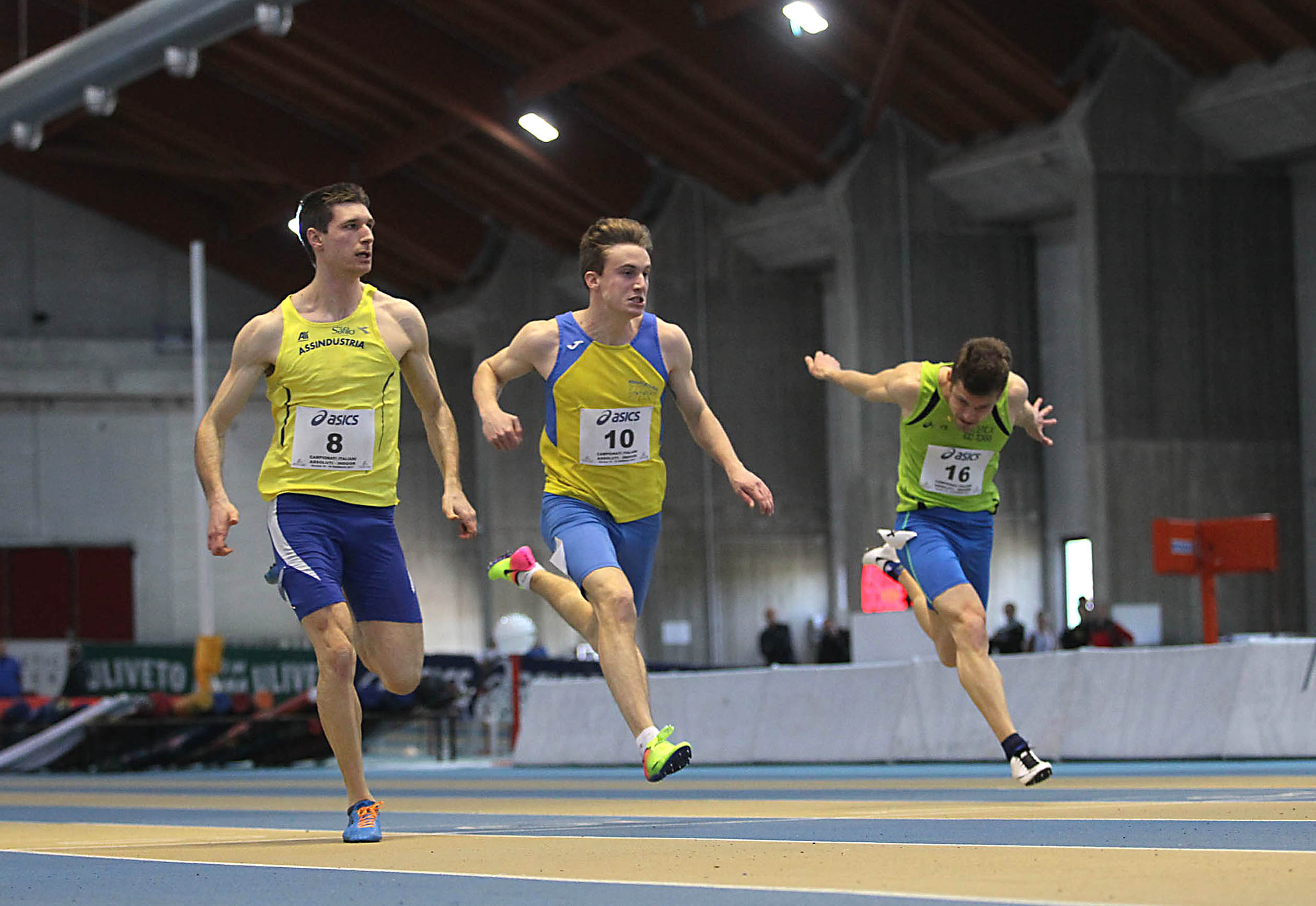
Lodovico Cortelazzo
Former national-team athlete. 15 years of training. Exercise science and engineering.
Fifteen years of training, eight at national level, give a specific kind of eye for what sport technology actually does versus what it claims to do. I combine a background in exercise science with hands-on engineering to build and analyse tools that are meant to work in the real world. If you are working on something in this space and want that perspective, reach out.
Work with me →