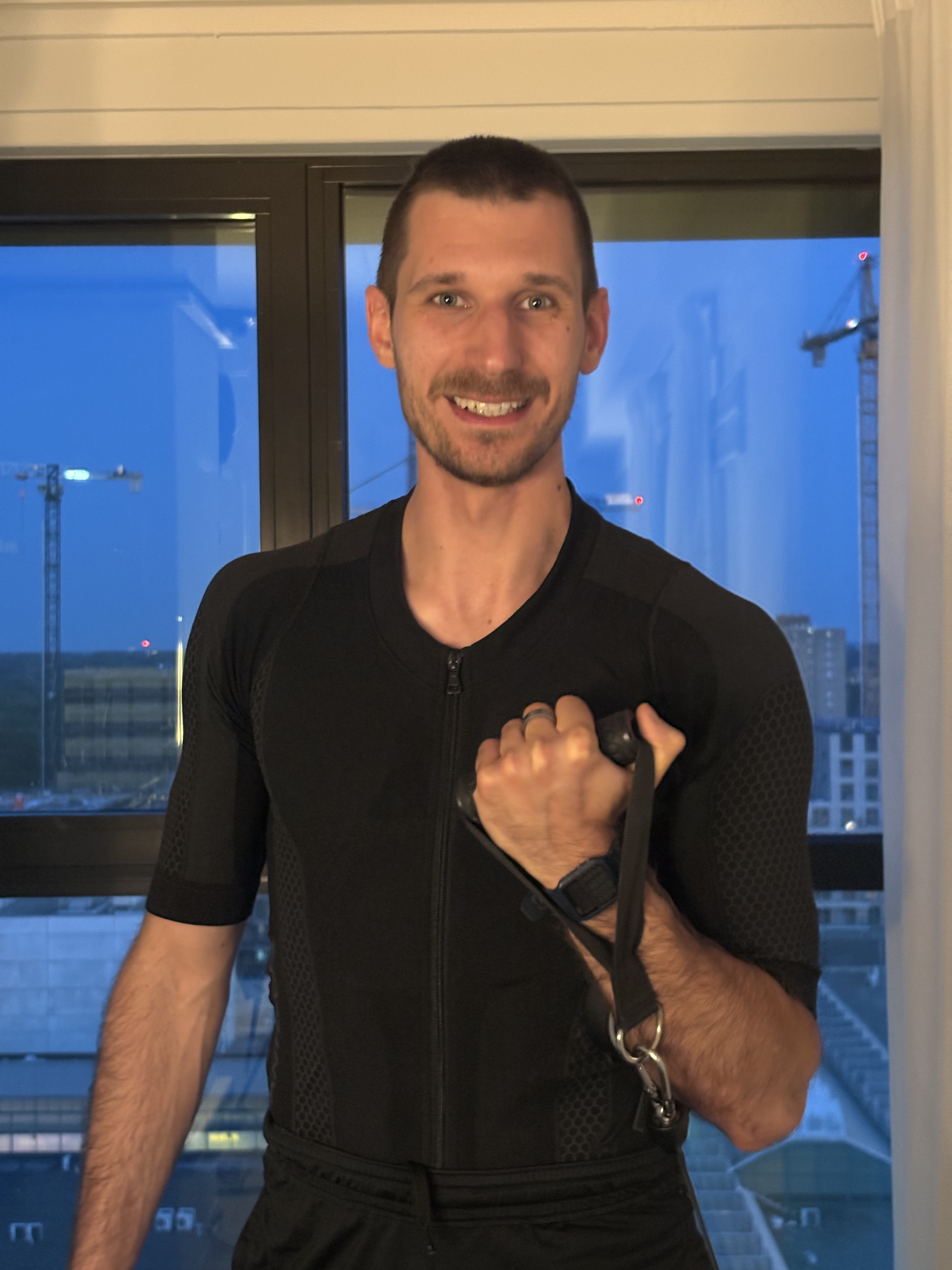
Former member of the Italian national athletics team, competing in the 200m sprint at national and European level from 2015 to 2019. Those years gave me a perspective on performance that no degree can replicate, what the body signals at its limit, and where conventional wisdom simply does not hold up.
After competition I studied Sports Science and Engineering, two cultures that rarely talk to each other, which is exactly the problem I am trying to solve. Today I design and build sport-tech hardware, sensors, embedded systems, computer-vision tools, and increasingly spend as much time on a different question: which problems are actually worth solving, and what it takes to turn a working prototype into something people can rely on.
Experience
Athletics, sports science, and engineering, in the order I actually lived them.
2015 – 2019
Italian National Athletics Team, 200m
Competed at national and European U23 level. The years that taught me how to read fatigue, signals, and performance long before I ever touched a sensor.
2019
Degree in Sport Science
Thesis on accommodating resistance training, the same subject I still write about today.
2019
First device: a wireless sprint chronometer
Built to time my own training sessions, because nothing affordable existed. The first real point where athletics and engineering met.
2019 – 2022
Personal Trainer & EMS Trainer
Coaching real athletes and clients, translating training theory into programs that had to work in the room, not just on paper.
2022
Degree in Electronic Engineering
The second half of the toolkit: circuits, embedded systems, signal processing.
2022 – 2024
Substation Engineer, Thytronic (Padova)
High-voltage substation engineering, learning how large, safety-critical systems are specified, protected, and kept running.
2025
Control Engineer, Netherlands
Industrial control systems, a different scale and discipline of engineering again.
2026 – Present
R&D Engineer & Founder, ODKI
Building sport-tech hardware professionally, and building ODKI, an open velocity-based training sensor, on the side. Where the question stopped being "can I build this" and became "what is actually worth building."
Related reading
-
Accommodating resistance: how bands and chains fix the fundamental flaw in barbell training
Why a constant-weight barbell is never the optimal load throughout a lift — and how variable resistance fixes it, what the research says about how much to use, and which exercises actually benefit.
-
Building a Device Is the Easy Half
From IMU to product: the decisions behind ODKI, an open VBT sensor — what to build, what to give away, and what I'm still learning.
How I think
First principles before received wisdom
I go back to fundamentals every time, sport is full of practices that were never properly questioned, and engineering often adds complexity where simplicity would work better.
Validate with a prototype, not a slide deck
A working prototype in front of real athletes tells you more in one session than months of planning. The field is ruthless and honest. A spreadsheet is neither.
Connect domains that rarely talk to each other
The most interesting solutions sit at disciplinary boundaries. Cross-domain thinking consistently produces ideas that neither field would have reached on its own.
Mission
Combine sport and engineering to push performance forward.
Vision
Lead the technology decisions, not just the technology, turning a deep understanding of sport into products and strategy that scale.
Latest articles
General
How I Would Have Won Physical: Italia
A technical breakdown of every challenge from Netflix's Physical: Italia, a feasibility score for each one given my own physical profile, and whether I actually could have won.
Oct 8, 2026
Sport
You're Not That Big. So How Are You Lifting That?
The muscle is the last thing that matters.
Oct 7, 2026
Technology & Innovation
Build vs. Buy: Why I Open-Sourced Part of ODKI Instead of Protecting It
The ODKI sensor was never a secret worth protecting. The real decision was about what to open, what to keep closed, and why interoperability turned out to be the actual business strategy.
Oct 6, 2026
Projects
Building a Device Is the Easy Half
From IMU to product: the decisions behind ODKI, an open VBT sensor — what to build, what to give away, and what I'm still learning.
Sep 29, 2026
Technology & Innovation
Why Better Gym Machines Won't Make You Fitter
The fitness industry keeps building better machines for the people least equipped to use them.
Sep 12, 2026
Engineering
IMU Sensors in Sport: Why Understanding Quaternions Is Non-Negotiable
When a barbell rotates, its IMU sensor stops measuring the right axis. Quaternions and the Madgwick filter fix this — here is how they work and why every sport sensor needs them.
Sep 3, 2026
Sport
You're Not Overtrained. You're Lazy!
Overtraining is real, but it's much harder to reach than most people think.
Aug 24, 2026
Engineering
I Let an AI Tune My Firmware for 40 Iterations. It Made Things Worse.
An honest account of trying to automate firmware parameter tuning with Claude Code, what the setup looked like, why it failed, and what it taught me about where AI actually breaks down.
Aug 4, 2026
Sport
The Heavy Legacy of Vittori and Mennea: How a Method Built Around One Outlier Held Back Italian Sprinting
A generation of sprinters ruined by a common misconception
Jul 9, 2026
Engineering
NRF24L01: the cheap 2.4 GHz radio that actually works in the field — if you know where it hides
A practical guide to building wireless sensor networks with the NRF24L01 — what makes it the right choice for sport-tech field devices, and the one hardware mistake that cost me over a year of troubleshooting.
Jun 21, 2026
Engineering
IMU sensors: why the accelerometer and gyroscope are useless alone — and powerful together
A clear explanation of what accelerometers and gyroscopes actually measure, why each one fails on its own, and how combining them with a complementary filter solves both problems at once.
Jun 20, 2026
Sport
Accommodating resistance: how bands and chains fix the fundamental flaw in barbell training
Why a constant-weight barbell is never the optimal load throughout a lift — and how variable resistance fixes it, what the research says about how much to use, and which exercises actually benefit.
Jun 19, 2026
Sport
Velocity-Based Training: how bar speed tells you more than the weight on the bar
A practical guide to VBT — what it measures, why it beats percentage-based programming for finding your optimal training load, and which exercises actually benefit from it.
Jun 18, 2026
Projects
How I Turned a Cheap Alarm Clock Into a Heads-Up Display for My Runs (Part 2)
Wiring the ESP32, staring down a Chinese datasheet, and spending half a day brute-forcing a segment map — until the display finally showed the right number.
Jun 17, 2026
Projects
How I Turned a Cheap Alarm Clock Into a Heads-Up Display for My Runs (Part 1)
Reverse-engineering a projection alarm clock, an ESP32, and a heart-rate strap into a training device that throws my data on the wall in front of me.
Jun 16, 2026
General
Welcome — where sport meets the soldering iron
Former national-team athlete, dual degrees in Sport Science and Engineering, fifteen-plus years of daily training. This is where I write about all of it.
Jun 15, 2026
Building something in sport-tech?
Working on a sport-tech idea? I can help you stress-test assumptions, validate quickly, and figure out what to build first.