How I Would Have Won Physical: Italia
This one is different from what I usually write. I watched Physical: Italia, the Italian spin-off of Netflix’s Physical: 100, and I could not stop analysing every challenge through the same lens I use for everything else on this blog: what does this actually demand from the body, and who is built to win it.
So this is half technical breakdown, half a game I am playing with myself: given my own physical profile, how would I have approached each of the seven major challenges, and would I have made it to the final. I am also scoring each challenge for how feasible my plan actually was, from 1 to 10, and averaging it at the end.
My profile, for context
76kg, 182cm. Very high relative strength and explosiveness for my size.
Strong: maximal strength and strength-endurance (the ability to keep producing high force output under repeated or sustained demand). Weak: aerobic endurance is not high. Tactical reading and game intelligence under pressure are not strong points either, those are genuinely two of my weaker attributes, alongside aerobic capacity.
The one challenge that worried me most just from reading the format: the timed obstacle circuit in the final. It combines exactly the two things I do not have, endurance and obstacle-clearing technique I have never trained. A deleterious combination for me, specifically.
1. The Grid Plank
The challenge: An isometric hold on a grid of bars suspended above water, hands gripping one bar, feet resting on the edges of the structure, for as long as possible. The winner of this heat, CrossFit athlete Elisa Fuliano, held on for over an hour and twenty-seven minutes.
What it takes: Core strength alone does not win this. Bodyweight matters enormously: being lighter directly reduces how much force your fingers, forearms, and feet have to resist isometrically for the entire duration, and lowers the metabolic cost of holding the position per minute. Beyond that, it is physical endurance and, even more, mental endurance. Positioning technique, finding a stable configuration early that distributes load across shoulders, core, and legs rather than letting it all collapse onto the grip, matters as much as raw stamina.
My strategy: I would have found a comfortable set of positions early and rotated through them on a cycle, rather than holding one static position until it broke down. Stamina would do the rest. Surviving as long as possible here has a second-order benefit beyond this one heat: it earns the right to choose your arena and your opponent in the next challenge. I would have aimed to finish in the top 20.
Feasibility: 7/10. My bodyweight is on the lighter side and my strength-endurance is a genuine strength, but this challenge also rewards a kind of patient, low-arousal mental endurance that is not naturally where I excel.
2. The Duels
The challenge: Three-minute one-on-one contests for control of a ball, with the finisher choosing between a strength arena (wrestling, grappling) and an agility arena (sprinting, footwork, obstacle evasion). Olympic Greco-Roman wrestling champion Andrea Minguzzi beat Hyrox athlete Luca Palla in one of their duels; wrestlers tend to dominate hard in the strength arena specifically, which is the clearest sign of how decisive the arena choice itself is.
What it takes: In the strength arena, wrestlers are playing a home game: grips, leverage, and wrestling technique decide it, almost independent of general fitness, because grappling exchanges are won on technical skill and reaction to grip pressure, not raw conditioning. The agility arena rewards straight-line acceleration, reaction time, and the ability to change direction under pressure without losing speed. It is genuinely interesting watching different builds dominate depending purely on which arena got picked.
My strategy: Agility arena, without hesitation, given my profile. I would have deliberately picked a much bigger opponent than me, hoping their size came with less agility than mine, since mass and lateral acceleration tend to trade off against each other. If they had caught me, that would have been the end of it, but the bet favours my strengths.
Feasibility: 8/10. Straight-line speed and change of direction are close to the most transferable qualities from sprinting there are. This is the challenge where my athletic background maps most directly onto the task.
3. The Forgotten Temple
The challenge: Five-person teams rebuild a collapsed bridge from wooden planks, then carry sandbags across it to fill a column with sand. Whichever team fills their column with more sand within the time limit wins. Team composition mattered enormously here: an all-women team could not realistically compete against a team stacked with heavier, faster men.
What it takes: Strength and speed are non-negotiable, but this is a throughput problem more than a raw-power problem: the single-file bridge is the bottleneck, so the team’s output is capped by how fast bags can be filled, carried, and emptied in a continuous cycle, not by how strong any one person is. Strategy, set by the team captain, makes as much difference as physical ability.
My strategy: I would split the team’s labour into clear phases. Everyone carries planks to the build site first. Two people, the lightest or those who would otherwise carry the least load, stay behind to assemble the bridge. Everyone else starts filling sandbags and staging them near the bridge. The moment the bridge is ready, the two builders switch roles and become dedicated bag-fillers, while the rest of the team becomes a continuous relay: cross the bridge, empty a bag into the column, come straight back for the next one already filled, never idle. A team that commits to this kind of pipeline beats one that improvises mid-challenge almost every time.
Feasibility: 6/10. The strategy itself is sound and genuinely would work, but the outcome depends heavily on the other four people on the team, which is outside my control. Good logistics, uncertain execution.
4. The Pillars of Hercules
The challenge: An isometric hold, arms spread wide, gripping handles connected by chains to two pillars that fill with water at a constant rate, increasing the load continuously until someone lets go.
What it takes: This is grip and forearm endurance, not legs, not core, and it rewards short arms, not long ones: shorter arms mean a shorter moment arm between the shoulder joint and the hand, so the same horizontal pull from the chains produces less torque for the shoulder stabilizers and grip to resist. The real currency here is how long your forearm flexors can keep producing force under rising, unrelenting load.
My strategy: Grab the handles and hope my hands hold out longer than everyone else’s. There is no real tactic to hide behind here, just strength-endurance in its purest form.
A small aside worth knowing: grip strength is not just a party trick, it is one of the simplest, most studied proxies for general health in clinical and longevity research. One caveat though: what doctors actually measure is maximal grip force, using the handgrip test, a brief all-out squeeze on a dynamometer, not sustained grip endurance under a slowly rising load like this challenge. The two are related but not identical qualities. Still, this challenge was, even if imprecisely, testing something adjacent to a marker doctors genuinely care about.
Feasibility: 5/10. My own arms are on the long side, which if anything works against me here rather than for me, but pure grip endurance against the clock, with no technique to lean on, is close to a coin flip for anyone regardless.
5. The Chariot Race
The challenge: Four-person teams, one athlete harnessed to a chariot at a time, drag it across four laps with the load rising each lap: 100kg, then 110, 120, and finally 145kg.
What it takes: This has almost nothing in common with resisted sprint training, which is something I actually know a thing or two about. Sprint sled work is about preserving an acceleration pattern against added resistance. Here the load is so heavy and the speed so low that the task is really about overcoming static friction and sustaining a slow, grinding horizontal force against the ground, closer to a strongman yoke walk than a sprint. Total bodyweight contributes directly to how much vertical force you can convert into horizontal drive, so a heavier body is a genuine advantage rather than a liability.
My strategy: Team order matters: lighter or less powerful members on the early, lighter laps, your strongest pullers saved for the 145kg lap. Would I have pulled the heaviest lap myself? Almost certainly yes. I am not the heaviest build for this specific task, but strength, lactic tolerance, and stamina under heavy sustained load are exactly where my profile is strongest, and that matters more here than bodyweight alone.
Feasibility: 6/10. My strength-endurance is real, but this challenge quietly rewards raw mass in a way my build does not have. I would perform well without being the obvious first choice for the heaviest lap on build alone.
6. The Grid of Heroes
The challenge: Uninterrupted hanging from a bar above a pool, roughly an hour for the eventual winner. Elite athletes from wrestling and judo backgrounds dropped well before the one-hour mark.
What it takes: Functionally, the same demand as the Grid Plank: grip and shoulder endurance, specifically the local muscular endurance of the forearm flexors under constant isometric occlusion, where blood flow to the working muscle is restricted by the contraction itself, accelerating fatigue regardless of how aerobically fit you are elsewhere. There is also a very large mental component, since at some point every single competitor is in pain and the only thing left is tolerance for it.
My strategy: Honestly, the same approach as the plank: find the least costly position and grind. Whether my grip endurance specifically would have held up against an hour of this, I genuinely do not know.
Feasibility: 4/10. This is the most honest low score on this list. Elite athletes with excellent all-round conditioning failed well under the hour mark here, which tells me this quality does not reliably track with general strength or athleticism, including mine.
7. The Final
The challenge: Three stages. A timed obstacle circuit, five laps within a set limit. Then an escalating pull-up ladder: one minute on the bar, with the required rep count increasing by two every round, round after round, until failure. Then, for the last two standing, a push-of-war: both finalists stand on top of an aqueduct-style structure with a wall between them, and push, each trying to drive the wall, and the opponent, backward. The 2026 final lasted almost two hours before Emanuele Bruno finally pushed Tommaso Nisi back and won.
What it takes: The circuit needs genuine aerobic endurance and obstacle technique. The pull-up ladder needs a combination of raw pulling strength and the pacing discipline to not blow up early, since every submaximal round still accumulates central nervous system fatigue that carries into the next one. The push-of-war is almost entirely will, stamina, and the ability to keep producing force after everything else is already spent.
My strategy: The circuit is my weak point and I would treat it that way: no heroics at the start, just aim to clear all five laps comfortably inside the time limit and preserve everything else for what comes next. On the pull-up ladder, I would not grind out multiple early rounds chasing a marginal lead. I would go straight for broke on the single round that matters most, the most reps in one minute, arriving relatively fresh while an opponent exhausts themselves trying to out-round me earlier, since fresh maximal output beats fatigued maximal output every time. Pull-ups are not a weakness of mine, and I think that single decision could have won me that stage outright. On the push-of-war, I know myself well enough to know I would not have lasted two hours. I would have thrown everything I had into the first ten minutes and tried to end it before it became a war of attrition I was not built to win. I do not know if I would have reached the end. I know I would have made it uncomfortable.
Feasibility: 6/10. Three very different sub-challenges, three very different scores if I am honest: weak on the circuit, strong on the pull-up ladder, uncertain but dangerous on the push-of-war. Six is the fair blend.
The feasibility scorecard
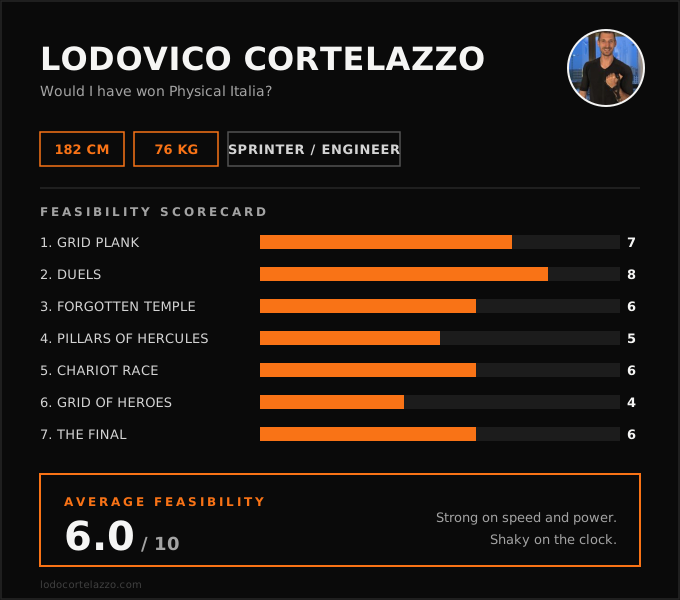
A 6 out of 10 average is not a confident prediction, but it is not a dismissal either. It is the honest shape of my profile: strong and credible wherever a challenge rewards short, violent, repeated effort or straight-line speed, genuinely uncertain wherever it rewards hour-long grip endurance or raw aerobic capacity.
So, would I have won?
Having actually scored it out, I am less pessimistic than when I started writing this. My profile is built for short, violent, repeated efforts more than for grinding attrition over hours, and this competition rewards both. But a 6 average, with an 8 on the one challenge (the Duels) where arena choice is basically a coin I get to weight in my favour, and a genuine shot at winning the pull-up stage of the final outright, means I would not bet against myself either. I might well have won.
What this exercise actually shows is the honest, slightly uncomfortable lesson underneath all of it: being strong is never the whole answer. Knowing exactly where your strength stops, and picking your fights accordingly, decides more of these outcomes than the show probably wants you to notice.
Now it is your turn. Score yourself, challenge by challenge, 1 to 10, average it, and see whether you would have walked away from Physical: Italia with the 100,000 euros, or just a very honest list of your own weak points.
Lodovico Cortelazzo
Former national-team athlete. Sports science and engineering. Building ODKI.
Fifteen years of training, eight at national level, give me a specific eye for what sport technology actually does versus what it claims to do. I combine that with hands-on engineering and product experience from building ODKI to figure out not just how to build sport-tech, but what is actually worth building. If you are working on something in this space and want that perspective, reach out.
Work with me →