Build vs. Buy: Why I Open-Sourced Part of ODKI Instead of Protecting It
The first thing to admit about ODKI is that the device itself is not novel. Velocity based training sensors already exist. Several companies have built one, some of them well funded, some of them selling units for years before I ever touched an IMU.
So when people ask if I was afraid of being copied, the honest answer is that the hardware was never the thing worth protecting. It was already prior art. Treating it as a secret would have meant guarding something that, functionally, everyone in the space already knows how to build.
The actual decision was somewhere else: what to open, what to keep closed, and why.
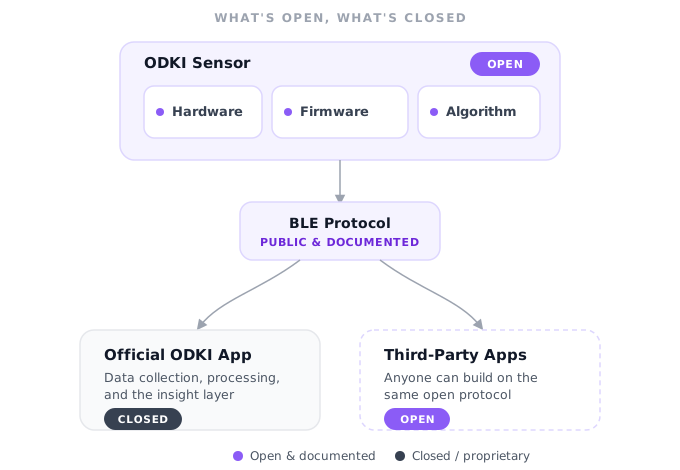
The device is open. The app is not.
ODKI’s firmware, the algorithm, and the Bluetooth protocol are fully documented and public. Anyone can read how the device works, build their own, or connect a completely different app to it using the same open protocol.
The app is different. That is where I draw the line, because that is where the real problem lives.
Collecting motion data off a barbell is a solved problem at this point. The hard part, the part nobody has really nailed yet, is what you do with that data once you have it: how you process it, what you surface to the athlete, and how you turn a stream of numbers into something that actually makes training more efficient. That is the layer I am still building, still experimenting with, and the one I am not giving away yet.
So the device is a platform, not a locked box. Use the official app, or build your own on top of the open protocol. Either way, the sensor itself was never the asset.
Why open the device at all, then
If the hardware is not a secret, keeping it closed anyway would only cost something: it turns the device into a black box.
Realistically, very few people will ever sit down and read the firmware or the algorithm documentation. But the ones who do matter a lot more than the number suggests. They are the ones who can actually confirm that the engineering is sound, that the drift correction is handled properly, that the thing does what I claim it does. That credibility does not come from a marketing page. It comes from being checkable.
There is a second reason, less certain and more hopeful. An open device is one a community can actually improve. I do not know yet if that community will show up. I am hoping people will find ODKI worth contributing to, not just worth buying. That part of the bet has not been proven yet.
A friend’s comment that stuck
A friend said something simple that reframed how I thought about this: if you keep everything closed and never share it, you never get to compare notes with anyone, and without that comparison, you do not actually improve.
That applies to a training log and it applies to a piece of firmware the same way. Secrecy protects you from being copied. It also protects you from ever finding out, from someone outside your own head, where you are wrong.
Where the protocol decision actually came from
This part did not come from sport tech at all. It came from my day job.
In substation and industrial control engineering, protocols get standardized on purpose, so equipment from different manufacturers can talk to each other without anyone needing special permission or a proprietary bridge. Interoperability is not a nice to have in that world. It is the default assumption the whole industry is built on.
That is where I was sitting when I decided the BLE protocol for ODKI had to be fully open and documented, no exceptions. Not because open source is trendy in hardware circles, but because I had already seen, in a much more conservative industry, that standard and open protocols are what let a whole ecosystem build on the same foundation instead of each company reinventing a closed one.
The actual business strategy
None of this is charity. Opening the device and the protocol while keeping the app closed is a deliberate bet on how trust gets built.
A closed device asks people to take my claims on faith. An open one lets them check. Documenting everything and keeping the protocol public is how I am trying to establish that ODKI means what it says, and that the principles behind it (accuracy you can verify, a device you are not locked into) are not just marketing language.
The app staying closed is where the actual value is supposed to concentrate, eventually. But I want to be clear that I am not presenting this as a strategy I know works. It is the strategy I chose, based on what I have seen work in a completely different industry and on a conversation with a friend that stuck with me longer than I expected. Whether it is the right call for a one person hardware project trying to become something more, I will only know by watching what actually happens next.

Lodovico Cortelazzo
Former national-team athlete. Sports science and engineering. Building ODKI.
Fifteen years of training, eight at national level, give me a specific eye for what sport technology actually does versus what it claims to do. I combine that with hands-on engineering and product experience from building ODKI to figure out not just how to build sport-tech, but what is actually worth building. If you are working on something in this space and want that perspective, reach out.
Work with me →